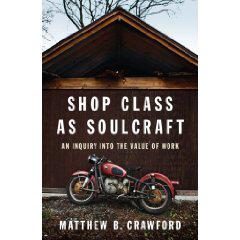
Shop Class as Soulcraft: An Inquiry into the Value of Work
by Matthew B. Crawford
Rating: 2.0 / 5 · Read · Finished 2025-02-19
I thought I was on board with the idea, but in the end it was mostly abstract nonsense. It’s a little ironic to read a theoretical book about the the benefits of practice over theory. I think I preferred The Glass Cage https://www.goodreads.com/book/show/25622254-the-glass-cage
Still here are some points I found interesting
- The main message is that hands-on jobs are just as valuable or maybe more valuable than knowledge work. You don’t have to go to college. That seems especially relevant today, as it looks like AI will replace all remote work. In the future, there will only be two jobs left: startup founder and HVAC technician, and the HVAC technician will earn more. The distinction isn’t high-skill and low-skill jobs. It’s jobs that can be transmitted through a wire and those that can’t.
- When the author worked in an office, he was tired at the end of each day. When we worked as electrician, he wasn’t. I relate. If I work at a desk all day, I feel tired.
- You’ve got to build theories on top of examples and direct experience. You can’t learn the theories directly (or they won’t make sense to you). Start with the practice, then the theory will make sense and be relevant to you.
- If you can’t diagnose and fix your own stuff, there is a conflict of interest. The manufacturer tells you when to repair vs replace. And of course they want you to buy more. Plus, with the ongoing labor shortage, it takes long time to get things repaired. Outsourcing responsibility for maintenance exposes you to bureaucracy. Think about trying to schedule a plumber. And they may have more plumbing knowledge but less knowledge about your house in particular.
- Counter argument to opportunity cost: Time is not fungible. We want variety.
- I loved the whole chapter about his desk job. Absurdity. He wrote abstracts to papers he didn’t understand, which already had abstracts written by the author. His boss only made grammatical corrections, because he also couldn’t understand the abstracts. And the companies buying the abstracts probably didn’t ask their employees if they were useful.